
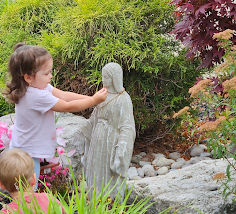
Loving as Jesus Loved: Lessons at Home and in the Heart
One Sunday as we sat together after Mass, my children and I reflected on the Gospel reading from John. It’s the moment when Jesus, knowing He will soon leave His disciples, gives them a new commandment:
“Love one another. As I have loved you, so you also should love one another. This is how all will know that you are my disciples, if you have love for one another.” (John 13:34-35)
It’s such a simple yet profound command. But what does it really mean to love others as Jesus loves us?
We began by talking about the kind of love Jesus showed—healing, forgiving, protecting, encouraging, and ultimately laying down His life for others. That kind of love is not passive or just sentimental. It’s active. It’s deeply selfless, like his sacrifice for us.
So then the question for me became: How do I bring this into the lives of my children? What does Christ-like love look like in the world of a child?
As we explored this as a family, the answers that emerged were beautiful in their simplicity: helping a neighbour, donating toys or clothes, being a good friend, including someone left out at recess, doing chores around the house. These are tangible, meaningful acts of love.
But we also talked about something deeper—the motivation behind the act. So often, our culture celebrates good deeds that are performed for an audience. Social media is full of videos of “random acts of kindness” filmed for likes, shares, and praise. While these actions may help someone, they are not always grounded in the selfless love Christ calls us to.
True love—the love Jesus modeled—is quiet. It’s not done for recognition. It’s not posted or praised. It’s done because loving others is the right thing to do, even (and especially) when no one is watching.
And yet, this is hard—even in our own homes.
I hear it all the time from my children:
“Mom! I did the dishes for you!”
“Mom! I cleaned the laundry room for you!”
And yes—of course we celebrate and affirm their contributions. Encouragement is part of parenting. But I also hope that as they grow, they begin to internalize this greater truth: love doesn’t need an audience. Love, in its purest form, gives without expecting anything in return.
One day, I hope my children become men who serve others not for praise, but from a deep sense of compassion and faith. That they help not just when asked, but because they feel compelled to love others the way Jesus did—humbly, consistently, and without condition. Perhaps one day, the act of doing something won’t need an announcement or call for accolades – that doing something out of love will be enough.
How Can We Encourage Our Children to Love Like Jesus?
Here are a few simple ways we can help our children grow into this Gospel call:
- Talk about motivation: Ask your child why they did something kind. Help them name the feeling that comes from doing good—not for attention, but because it’s right.
- Model quiet service: Let them “catch” you doing something generous or kind without drawing attention to it. Then, talk about how God sees every act of love, even the hidden ones.
- Celebrate the feeling, not the applause: When your child helps, thank them—and ask, “How did it feel to do something kind?” This reinforces the internal reward rather than the external praise.
- Share stories of saints and people of faith who lived lives of service quietly and faithfully.
- Practice anonymous giving: Have your family do something kind for someone (a note, a treat, a surprise) without telling them it came from you.
- Use the language of discipleship: Remind your children that “they will know we are Christians by our love”—not by our trophies or attention, but by our actions rooted in fa
A Song to Carry This Message
One of the most enduring hymns that echoes this Gospel is “They Will Know We Are Christians by Our Love.” Consider listening to it as a family, using it as a prayer, or reflecting on its lyrics as part of your mealtime or bedtime routine.
Listen here
As parents in Catholic education, we are called to form not just minds, but hearts—hearts that reflect the love of Christ in the quiet moments, in the unseen actions, and in the small ways our children grow in faith each day.And though the world may not always see those acts, we can trust that God does—and that, truly, is what matters most.