
The Binder on the Floor: Navigating High School IEPs as a Parent
It felt like a big leap to high school—and a relief that we had survived Grade 8.
Looking back, the journey there was filled with phone calls, assessments, questions, and finally identification and an IEP. Having a child with ADHD (or other exceptionalities) presents in many ways—at home and at school—and while we had learned how to navigate elementary school, high school felt different.
At first, everything seemed fine.
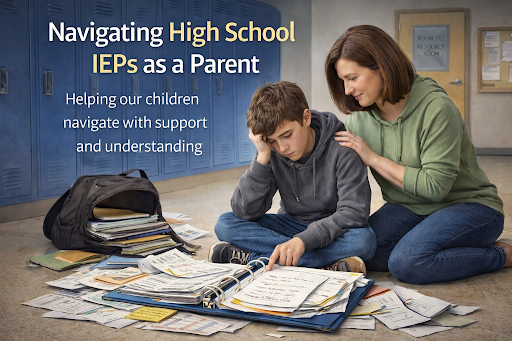
Until one afternoon, when THAT binder fell out of a backpack.
Papers were jammed in at every angle—unfinished work, overdue assignments, and major due dates all mixed together. That binder wasn’t just a mess of paper. It was a snapshot of a student being asked to manage more than they were ready to carry alone.
What Changes in High School
In elementary school, IEP support often feels automatic. Teachers checked in.Resource time was scheduled. Adults helped organize, remind, and redirect. In high school, the IEP still exists—but students are expected to manage more independently with multiple teachers, overlapping deadlines, and self-advocacy is expected – which often means booking their own support time.
For students with ADHD, anxiety, or executive functioning challenges, this shift can be overwhelming. The binder on the floor, filled with papers, assignments and notes is often a sign—not of laziness—but of skills still developing.
Understanding the IEP and IPRC
Many students with learning exceptionalities may have an IEP (Individual Educational Plan). An IEP outlines a student’s exceptionalities and the supports they need. Sometimes this includes accommodations—changes in how learning or assessment happens, such as extra time, oral assessments, scribing, or access to technology. In some cases, it may include modifications, such as fewer expectations or adjusted levels of assessment.
In high school, these conversations often happen through an IPRC meeting, where parents can review the IEP, discuss strengths and needs, and ensure supports are clearly understood. Knowing what’s in your child’s IEP helps you advocate effectively.
Our Role: Advocate, Engage, Empower
In Highschool, our role as parents changes, but does not end.
We are called to advocate when supports aren’t working, engage early with teachers and the school, and empower our children—supporting them without rescuing, and scaffolding independence over time. One of the most important things I’ve learned is the value of early communication: Go to the interviews.Attend the open houses. Meet the teachers early in the semester. Introduce yourself—not to demand, but to collaborate.
A simple conversation can make a difference: Share how your child learns best; Ask how accommodations are being implemented; Clarify expectations and timelines; Ask who your child should approach when they feel overwhelmed. Opening the dialogue early builds trust and sets a tone of partnership. It also helps teachers see your child as more than a name on a class list—as a whole person.
A Final Reflection
High school invites us to encourage our children to begin advocating for themselves—to know their accommodations, to understand their accommodations, to ask for help, and to keep communication open with their teachers.
As parents we engage by checking in, guiding, and reminding them that support is always there, And little by little, we begin to let go – not all at once, and not without care, but we slowly loosen our grip as our children learn to guide themselves. Still, we remain beside them, ready to advocate when something isn’t working and to step in when needed.
As Catholic parents we are reminded that our children are more than just grades, evaluations, awards or binders on the floor. They are gifts from God – wonderfully made, known, and loved. In the midst of all the struggles and challenges we need to remind ourselves that struggle doesn’t mean failure and support is not weakness; it is an act of love. The IEP is a tool to help our children succeed, one that can change as their needs change. By staying in contact with teachers and resource staff, we empower our children by modeling that asking for help is okay. We may not clear every obstacle – but we are there beside them, as they learn to carry more on their own – and sometimes that may simply be to sit beside them on the floor with THAT binder – and begin again.