
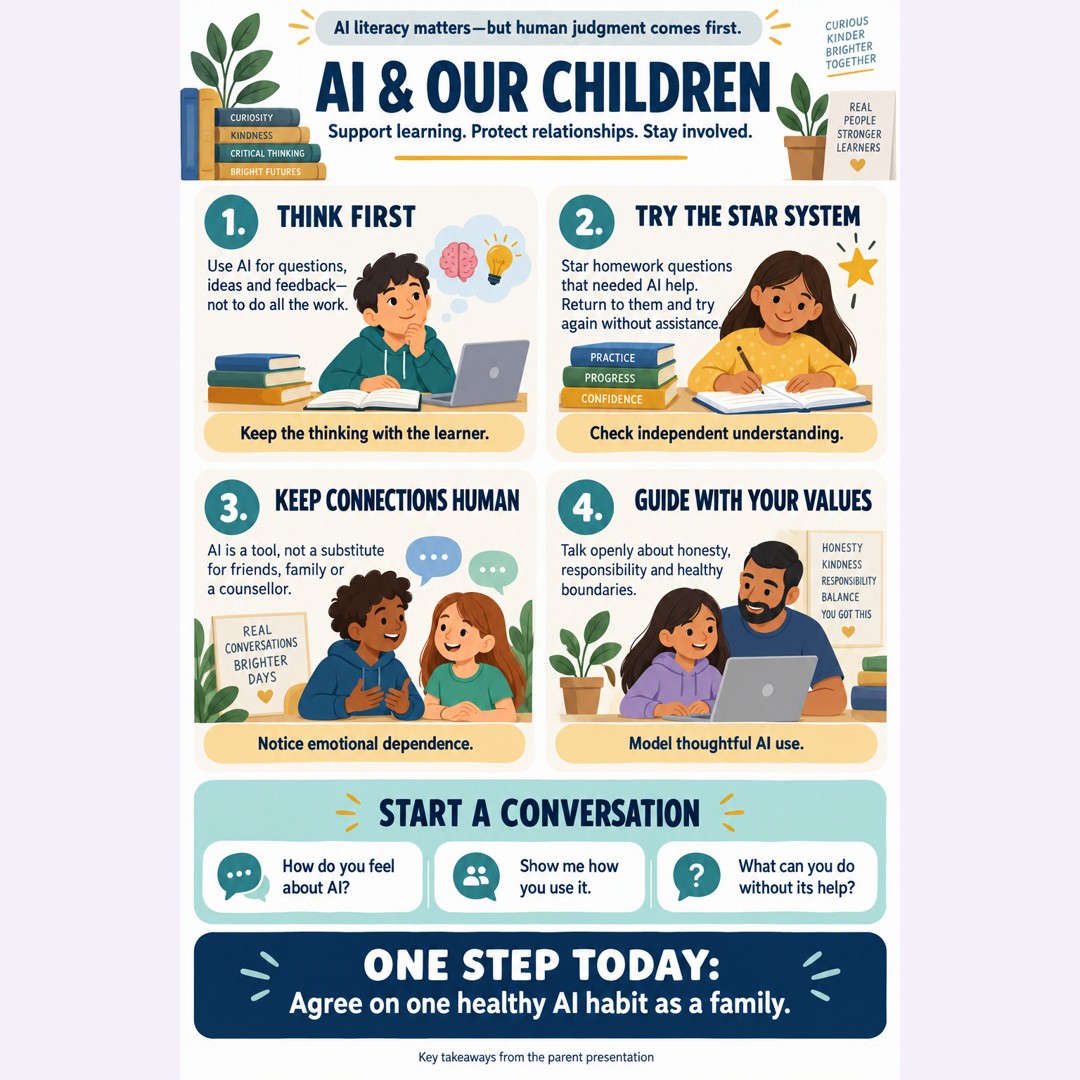
Use AI to Support Thinking, Not Replace Thinking
Research involving university students showed positive outcomes when students used AI as a learning partner rather than letting AI do the work.
Effective use included:
- Brainstorming ideas
- Asking questions
- Receiving feedback
- Refining thinking
Ineffective use included:
- Having AI write the entire assignment
- Copying and pasting AI-generated work
The key takeaway:
Students learn best when they continue to struggle, think, revise, and engage actively with their work while using AI as support.
The “Star System” for Homework
Giancarlo shared a practical strategy used at home.
When children use AI for homework:
- Put a star beside any question where AI assistance was needed.
- Children should be able to identify which work they could complete independently and which required AI support.
This:
- Encourages honesty.
- Helps parents identify learning gaps.
- Ensures AI is helping rather than replacing learning.
A Major Concern: AI as a Friend or Emotional Companion
One of the strongest warnings in the presentation concerned children using AI as:
- A friend
- A confidant
- A counsellor
- A substitute for human relationships
Giancarlo noted that:
- Many children are already interacting with AI this way.
- AI systems are intentionally built to feel highly empathetic.
- This can create unhealthy emotional dependence.
Parents were encouraged to:
- Ask children how they use AI.
- Discuss differences between AI relationships and human friendships.
- Pay attention if children regularly confide in AI instead of people.
Giancarlo suggested this is becoming a significant child-development concern globally.
The Importance of Family Values
Rather than focusing solely on technology rules, Giancarlo encouraged parents to use their family’s moral framework and values to guide decisions about AI.
Conversations should include:
- What role should AI play in our lives?
- When is AI helpful?
- When should we rely on human relationships instead?
- How do our values influence how we use technology?
Overall Takeaways
- AI is not going away; it is becoming a fundamental literacy.
- Students and young people are already using AI extensively.
- Employers increasingly value AI skills.
- AI can improve learning and productivity when used appropriately.
- Critical thinking must remain central to learning.
- Parents should monitor and guide AI use rather than prohibit it.
- Children should not treat AI as a replacement for human relationships.
- Family values should guide decisions about AI use.
Giancarlo’s central theme was not whether children should use AI, but how they should use it. Parents, schools, and communities share responsibility for ensuring that children’s encounters with AI maximize learning, creativity, and opportunity while minimizing potential harms.