OAPCE-Ontario Association of Parents in Catholic Education

Parent Resources

Supporting Math Learning at Home

Math can feel challenging for many students, but with the right support at home, parents can make a big difference in building confidence and skills. Here are some practical ways to help: Math is everywhere! Involve your child in activities like: These real-world examples show how math is useful and fun. Free platforms like Khan Academy, IXL, and Prodigy offer interactive lessons and games that make learning engaging. These tools allow children to practice at their own pace and reinforce classroom concepts. Remind your child that mistakes are part of learning. Praise effort, not just correct answers. Statements like “You worked hard on that problem!” help build resilience and confidence. Board games like Monopoly or card games like Uno can strengthen counting and strategic thinking. Apps such as DragonBox and SplashLearn turn math into playtime. Stay informed about what your child is learning in class. Ask teachers for tips or recommended resources to reinforce specific skills at home. Here’s a helpful list of resources parents can use to support their children with math: 1. Online Learning Platforms 2. Printable Worksheets & Activities 3. Apps for Mobile Devices 4. Video Tutorials 5. Local & Community Resources 6. Interactive Tools GeoGebra – Visual math tools for geometry and algebra.

Supporting Math Learning at Home Read More »

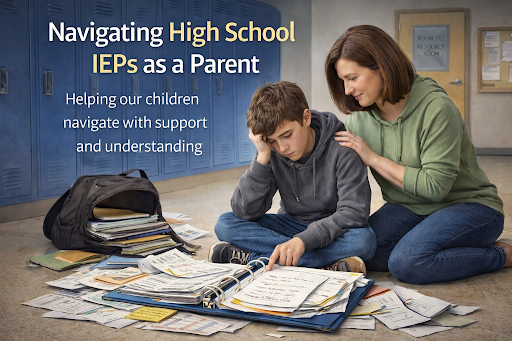
The Binder on the Floor: Navigating High School IEPs as a Parent

The Binder on the Floor: Navigating High School IEPs as a Parent It felt like a big leap to high school—and a relief that we had survived Grade 8. Looking back, the journey there was filled with phone calls, assessments, questions, and finally identification and an IEP. Having a child with ADHD (or other exceptionalities) presents in many ways—at home and at school—and while we had learned how to navigate elementary school, high school felt different. At first, everything seemed fine. Until one afternoon, when THAT binder fell out of a backpack. Papers were jammed in at every angle—unfinished work, overdue assignments, and major due dates all mixed together. That binder wasn’t just a mess of paper. It was a snapshot of a student being asked to manage more than they were ready to carry alone. What Changes in High School In elementary school, IEP support often feels automatic. Teachers checked in.Resource time was scheduled. Adults helped organize, remind, and redirect. In high school, the IEP still exists—but students are expected to manage more independently with multiple teachers, overlapping deadlines, and self-advocacy is expected – which often means booking their own support time. For students with ADHD, anxiety, or executive functioning challenges, this shift can be overwhelming. The binder on the floor, filled with papers, assignments and notes is often a sign—not of laziness—but of skills still developing. Understanding the IEP and IPRC Many students with learning exceptionalities may have an IEP (Individual Educational Plan).  An IEP outlines a student’s exceptionalities and the supports they need. Sometimes this includes accommodations—changes in how learning or assessment happens, such as extra time, oral assessments, scribing, or access to technology. In some cases, it may include modifications, such as fewer expectations or adjusted levels of assessment. In high school, these conversations often happen through an IPRC meeting, where parents can review the IEP, discuss strengths and needs, and ensure supports are clearly understood. Knowing what’s in your child’s IEP helps you advocate effectively.   Our Role: Advocate, Engage, Empower In Highschool, our role as parents changes, but does not end. We are called to advocate when supports aren’t working, engage early with teachers and the school, and empower our children—supporting them without rescuing, and scaffolding independence over time.  One of the most important things I’ve learned is the value of early communication: Go to the interviews.Attend the open houses.  Meet the teachers early in the semester. Introduce yourself—not to demand, but to collaborate. A simple conversation can make a difference: Share how your child learns best; Ask how accommodations are being implemented; Clarify expectations and timelines; Ask who your child should approach when they feel overwhelmed. Opening the dialogue early builds trust and sets a tone of partnership. It also helps teachers see your child as more than a name on a class list—as a whole person. A Final Reflection  High school invites us to encourage our children to begin advocating for themselves—to know their accommodations, to understand their accommodations, to ask for help, and to keep communication open with their teachers.  As parents we engage by checking in, guiding, and reminding them that support is always there, And little by little, we begin to let go – not all at once, and not without care, but we slowly loosen our grip as our children learn to guide themselves.  Still, we remain beside them, ready to advocate when something isn’t working and to step in when needed.     As Catholic parents we are reminded that our children are more than just grades, evaluations, awards or binders on the floor.  They are gifts from God – wonderfully made, known, and loved.  In the midst of all the struggles and challenges we need to remind ourselves that struggle doesn’t mean failure and  support is not weakness; it is an act of love.  The IEP is a tool to help our children succeed, one that can change as their needs change.  By staying in contact with teachers and resource staff, we empower our children by modeling that asking for help is okay.   We may not clear every obstacle – but we are there beside them, as they learn to carry more on their own –  and sometimes that may simply be to sit beside them on the floor with THAT binder – and begin again. 

The Binder on the Floor: Navigating High School IEPs as a Parent Read More »

Cyberbullying Presentation

Cyberbullying is a form of bullying that takes place through digital devices such as phones, computers, and tablets. It occurs on platforms like social media, messaging apps, online forums, gaming communities, or any space where people interact online. Cyberbullying can include sending hurtful messages, spreading rumors, posting embarrassing photos or videos, impersonating someone, or intentionally excluding someone online. Unlike traditional bullying, cyberbullying can happen anytime, reach a wide audience quickly, and sometimes be anonymous, making it especially harmful. Its effects can be emotional, psychological, and even physical, impacting a person’s self-esteem, mental health, and sense of safety. Promoting kindness, reporting harmful behavior, and supporting those affected are important steps in preventing cyberbullying. Here is a great resource from Media Smarts to know and understand better!

Cyberbullying Presentation Read More »

Supporting Students Through Ontario’s Menstrual Equity Initiative

Did you know that there are free menstrual products in schools for girls through the Ministry of Education in partnership with Shoppers Drug Mart? The Ministry of Education’s Menstrual Equity Initiative in Ontario provides free menstrual products to students across the province through school boards and authorities. The program is supported by donations from Shoppers Drug Mart, which first contributed products in 2021–22 and has since expanded its commitment. A new three-year agreement (2024–27) will supply 23 million products, allocated according to student enrolment data. The initiative aims to eliminate financial barriers and reduce stigma so students can fully participate in school.Key Features of the Ontario InitiativeFree access to products Students receive menstrual products—pads and tampons—at no cost.Public–private partnership The program is delivered through a partnership between the Ministry of Education and Shoppers Drug Mart, which donates a substantial supply of products.Funding and distributionFunding: Shoppers Drug Mart will provide 23 million menstrual products over three years beginning in the 2024–25 school year. Support for students Financial relief: The initiative reduces the financial burden on students and families. Inclusion: It fosters a more inclusive and supportive school environment.Educational focus: By removing concerns about access to menstrual products, students can concentrate more fully on learning.Implementation details: Dispensers: In 2024–25, 1,380 dispensers were installed to support product access.Allocation: Product quantities for each board are determined using enrolment data from the Ontario School Information System (OnSIS).https://news.ontario.ca/en/release/1000941/ontario-launches-free-menstrual-products-in-schools

Supporting Students Through Ontario’s Menstrual Equity Initiative Read More »

Cyber Awareness Month 2025

📘 K–12 Cyber Awareness Month 2025: Parent & Guardian Guide This October, empower your family to stay safe, smart, and secure online. The K–12 Cyber Awareness Month campaign by ECNO and the Ministry of Education provides free, expert-designed resources to help families and schools build a culture of cyber awareness. 💡 Inside the guide:✅ 10 practical steps for parents to model cyber safety✅ Conversation tools for digital wellness and online kindness✅ Grade-specific themes — Cyber Heroes Unite (K–8) and Digital Me (9–12)✅ Posters, videos, and lesson ideas to spark meaningful discussions 📅 Explore resources, activities, and more at www.k-12cyberawareON.ca 🔗 Download the full Parent & Guardian User Guide

Cyber Awareness Month 2025 Read More »

shine on method

PARENTS! The digital world is shaping our YOUTH – are you leading the way or just barelykeeping up?Get the ultimate advantage. -understand the real impact of digital life on teens-Gain practical tools to create balance and boundaries-Strengthen family connections and thrive in a tech-driven worldLucy Colangelo, Student Success Coach & Communications Expert helps your family learnhow to turn technology into a tool forsuccess and growth.As a former marketing and communications strategist. Lucy now uses her education andexperience to help families and educators bridge the digital divide, fostering strongerrelationships and setting young people up for success.We look forward to working

shine on method Read More »

ECNO

The Educational Collaborative Network of Ontario (known to our members as ECNO) isproud to play an important role in the Ontario education system.Our strength comes from our members: Ontario’s 72 school Boards and a growing list ofIndigenous education authorities. They all understand the value in having a collaborative,open, and forward-thinking collective interested in maximizing the impact of IT in 21stcentury education and administration.

ECNO Read More »

Thumbs Down. Speak Up

  Thumbs Down. Speak Up. (TDSU) provides you with the tools you need to set your kids up for success before they start interacting online. With the TDSU approach, you can feel confident that your children will be armed with the skills they need to be safe and responsible. Whether we like it or not, technology plays an important role in our kids’ lives. They use it to socialize, experiment with their identities, exercise their voices, and learn about the world. It’s no wonder that we want to shield our children from harm when they are online. But when we let worries about keeping our kids safe dictate how we protect them, we can overlook teaching them the skills they need to navigate their online lives without our constant oversight. Learn More

Thumbs Down. Speak Up Read More »

Scroll to Top